Engineers Without Borders: Sharing skills and learning about new cultures
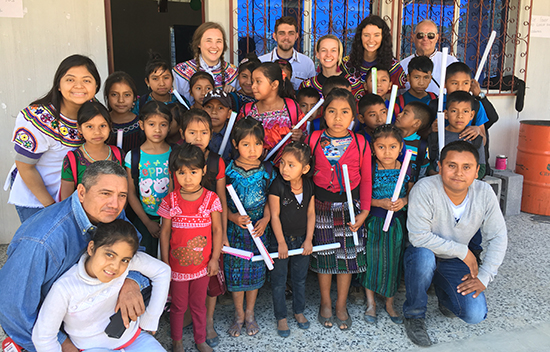
Bernadette Drouhard, Kansas State University senior in chemical engineering and member of Engineers Without Borders, traveled to Guatemala during semester break, taking part in a team project involving design and construction of a septic system. She shared her experiences in a recent first-person account.
Over the course of the last year, I had the amazing opportunity to work as the sanitation design lead for the Kansas State University student chapter of Engineers Without Borders, or EWB-KSU. In 2016, chapter members of EWB-KSU completed design and construction of a school for 30 to 50 students in the El Amate community outside of Joyabaj, Guatemala. The former school structure had a pit latrine as well, which was selected by the community as the next project for improvement as its lifetime was coming to an end.
In my role as sanitation design lead, I helped design a new septic system for this community, beginning with an alternatives analysis, and ending with implementation and construction of the system on site in January 2018. After extensive research, consultation with our faculty adviser and professional mentors, and many conversations with the community leadership, we had determined the best solution for on-site wastewater treatment at El Amate was a septic tank and leach-field system. Much of the design was completed during last summer, demonstrating the commitment of our team to find a solution that was both affordable and sustainable.
In January of 2018, our team of six traveled to El Amate, spending six days and five nights in the community to manage the excavation and consult with our contractor during initial construction of the system. Although the construction was exciting, meeting our community members in person was by far the best part of the trip. We held several meetings with the community leadership to discuss the sanitation project, as well as priorities for possible future projects since our partnership agreement does not expire until 2020. We also visited four different homes within the community to gain a better understanding of the indigenous culture and to strengthen our relationship with community members. On our last day in El Amate, we held an educational session for the school children and their families where we taught them about the importance of good personal hygiene, and also distributed school supplies that had been donated by EWB-KSU members, our families, and local Manhattan businesses and teachers.
It is difficult to describe how valued and loved I felt while staying in El Amate. The community trusts us immensely and is working every day to improve the quality of life for its children. Although they have very little materially, on average earning less than $800 per household each year, they gave us so much — including fresh handmade tortillas and small gifts each day. I am extremely grateful to the chemical engineering department at K-State for providing $500 toward my plane ticket and helping make this experience a possibility. Following graduation this May, I hope to join a professional chapter of EWB and begin a career in wastewater treatment to better equip myself for future sanitation projects in Guatemala with Engineers Without Borders.
- Bernadette Drouhard