Professors join forces to bring awareness of collaborative research to the public
Science on Tap is a monthly gathering where Kansas State University scientists and engineers present and discuss their projects to the public in the relaxed and informal setting of the Tallgrass Taphouse in downtown Manhattan.
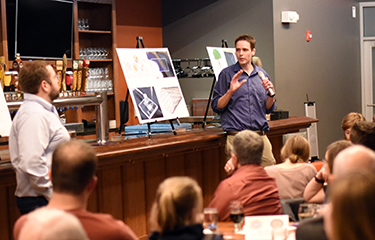 At a recent gathering for this event, Ryan Hansen, assistant professor of chemical engineering, and Tom Platt, assistant professor in the division of biology, presented the interactive and engaging talk “Unlocking the invisible world of microbes.” With nearly 100 participants from the Manhattan community present, it was a full-house with a lot of enthusiasm to learn about the collaborative research underway at K-State.
Platt and Hansen discussed how microbes — bacteria, virus, fungi — impact many aspects of daily life including health, the food we eat, and disposal of waste we produce. They also broadly explained what a microbial community is, and how it often contains many different types of organisms that can interact with each other in a variety of ways. They discussed how understanding these interactions could be useful from an engineering perspective. For example, discovering types of bacterial species that can ward off microbial pathogens could teach us how to use bacteria as probiotic treatments. The professors also highlighted their new device, a microwell array, which is designed to test thousands of different bacteria formulations in a single test in order to identify optimal formulations for pathogen inhibition.
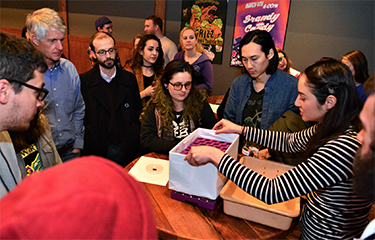 During the audience participation time, Platt engaged attendees in the “birthday game,” having them shouted out their birth dates in hopes of finding a match with someone else in the room. Several matches were quickly established, and this was used to illustrate the idea of the research — trying to find the right matches or combinations of bacteria. Participants took part in an interactive demonstration developed by Niloy Barua, Logan McGinley and Priscila Guzman, students working on the project, illustrating the principle behind the matching-making system of the microwell array. Volunteers poured a handful of colored marbles, representing different species of bacteria, into a scaled-up version of a microwell array and saw how the device could isolate unique combinations of marbles. The students then explained why it is useful to study these combinations in isolation. The evening concluded with a question-and-answer session between the audience and the research team.